
 by
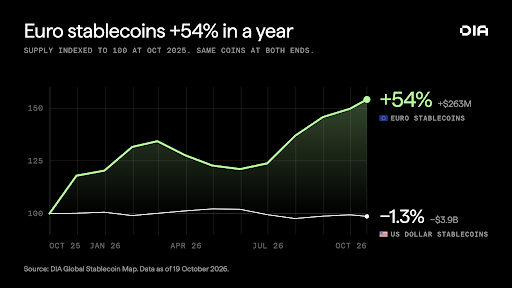
Zug, Switzerland, November 5th, 2026, ZEX PR WIRE, DIA, the trustless blockchain oracle network, today published “The New Stablecoin Fragmentation,” a large study of 140+ active stablecoins from nearly 100 issuers in 25 currencies, built on DIA’s Global Stablecoin Map, a public dashboard. It finds euro stablecoins added $263 million in the year to 19 October, up 54%, while dollar stablecoin supply fell 1.3%. At $790 million, the euro is now the largest non-dollar stablecoin market.
Banks already issue 29% of euro stablecoins, and a 37-bank consortium is next
SG-FORGE’s EURCV and Banking Circle’s EURI hold 29% of euro stablecoin supply. EURCV is the fastest-growing large euro coin, up two and a half times since March. Crédit Agricole launched its own coin, EURXT, in July. Qivalis, a consortium of 37 banks, received its Dutch e-money licence on 14 October and expects to issue within months. The ECB’s Pontes platform, which settles tokenized assets in central bank money, went live on 21 September.
Euro stablecoins carry 8.5% of onchain card spending, more than 30 times their share of supply
Euro stablecoin card spending reached $459 million in the twelve months to September, more than five times the prior year. Circle’s EURC accounted for 80% of it and Monerium’s EURe for the rest. That is 8.5% of all traceable onchain stablecoin card spending, against the euro’s 0.26% share of stablecoin supply.
Euro stablecoins are used in DeFi at more than ten times the rate of USDT
About 35% of euro stablecoin supply is deployed in DeFi, against 2.7% for USDT. On Token Terminal’s measure, a single Steakhouse-curated Morpho vault holds most of EURCV. Without that vault, the euro share falls to about USDC’s level of 12.9%. Euro lending markets total about €130 million, with roughly 72% borrowed. Meanwhile, ESMA told licensed firms in October to wind down custody and transfer services for non-compliant stablecoins such as USDT by early 2027.
“Two stablecoins can represent the same currency and still be entirely different products,” said Zygis Marazas, Head of Product at DIA. “A coin used for payments on Tron, one backing loans in DeFi and one listed on a MiCA-licensed exchange carry different risks, publish different proof-of-reserve disclosures and answer to different regulatory frameworks. Designing a stablecoin has to start with the rails it runs on, the customers it serves and the market it is built for.”
MiCA sets one rulebook across the EU, and 98% of euro supply is already licensed
Under MiCA, euro stablecoin issuers must hold full reserves and redeem at par. In December 2023, issuers now licensed under MiCA accounted for 27% of euro stablecoin supply. Today they account for 98%, and unlicensed coins have shrunk from €195 million to about €12 million.
Read the report and explore the data
Read the full report, “The New Stablecoin Fragmentation“. For every stablecoin, see supply by chain, peg stability, DEX liquidity, DeFi usage, frozen balances, who controls minting and freezing, and licence and reserve reports on the Global Stablecoin Map.
About DIA
DIA is a trustless blockchain oracle network. Its modular, rollup-based design enables verifiable sourcing and delivery of any data to any blockchain. The network is permissionless, allowing anyone to deploy oracles, operate nodes and participate as stakers in the distributed data sourcing process. For more information, visit diadata.org.
Data notes
DIA does not issue stablecoins. Data as of 20 October 2026; supply growth, the euro total and the euro’s share of supply as of 19 October 2026. Supply and growth come from DIA’s Global Stablecoin Map, which uses DeFiLlama circulating supply and DIA’s own onchain contract reads for coins DeFiLlama does not track. Growth compares the same coins at the end of October 2025 and on 19 October 2026, when they rose from $487 million to $750 million. Coins with no supply data a year earlier, mainly Banking Circle’s EURI, add about $39 million more. Card spending comes from Paymentscan, October 2025 to September 2026, and covers EURC and EURe spending whose funding is traceable onchain. DeFi share uses Token Terminal (12 October 2026); lending figures come from DIA’s lending data. The Global Stablecoin Map updates daily, so its live figures will differ from this 19 October snapshot.
Disclaimer: The views, suggestions, and opinions expressed here are the sole responsibility of the experts. No Economy Extra journalist was involved in the writing and production of this article.
